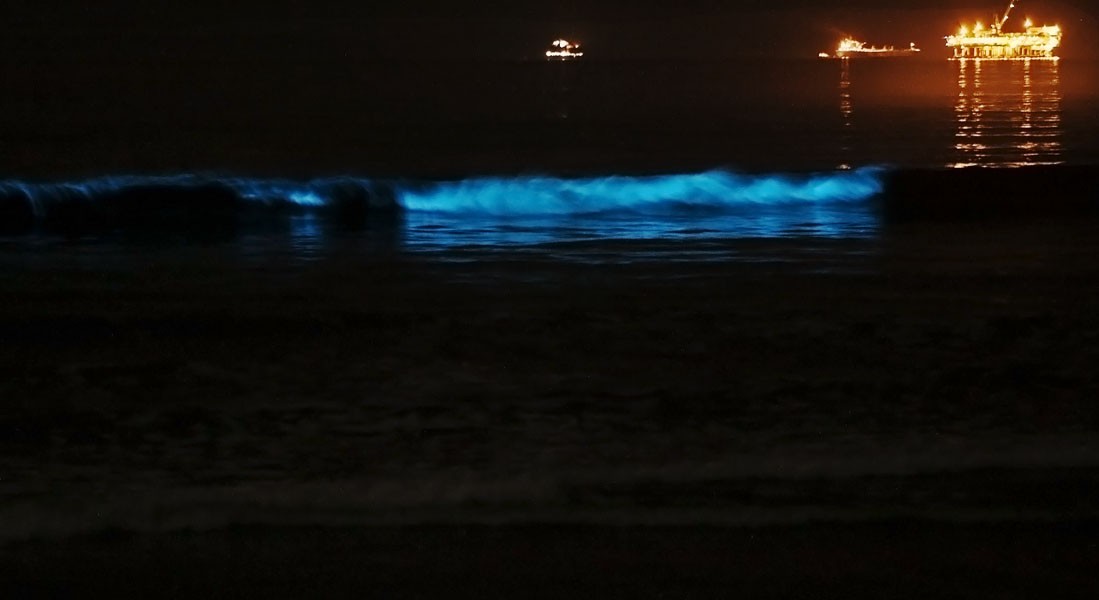
“Glowing plankton” undersells what’s actually happening at a cellular level, and we’d rather guests leave with the real mechanism than a vague sense of magic. The dinoflagellates in our bay produce light through a luciferin-luciferase reaction — the same broad chemical family (an enzyme oxidizing a light-emitting substrate) that fireflies use, arrived at independently through a completely different evolutionary path.
The trigger is mechanical, not visual or chemical: shear stress on the cell membrane, from a paddle stroke, a fish’s tail, or your hand moving through the water, opens mechanically-gated ion channels and triggers a rapid drop in the pH of an internal compartment called the vacuole. That pH drop activates the luciferase enzyme, which oxidizes luciferin and releases photons — mostly in the blue-green range around 474 nanometers, which is also close to the wavelength that travels furthest through seawater, not a coincidence.
The leading hypothesis for why this evolved at all is defensive, sometimes called the “burglar alarm” hypothesis: a startled flash doesn’t just startle the immediate predator (a fish grazing on the plankton), it lights that predator up, making it more visible to a secondary predator further up the food chain. It’s a real, testable evolutionary strategy, not an accident of chemistry.
A single flash lasts roughly a tenth of a second and takes real energy for the cell to produce — which is part of why calm, undisturbed water looks dark, and why the glow response can visibly fade within a bloom if the water’s been heavily disturbed for an extended period before it’s had time to recover.