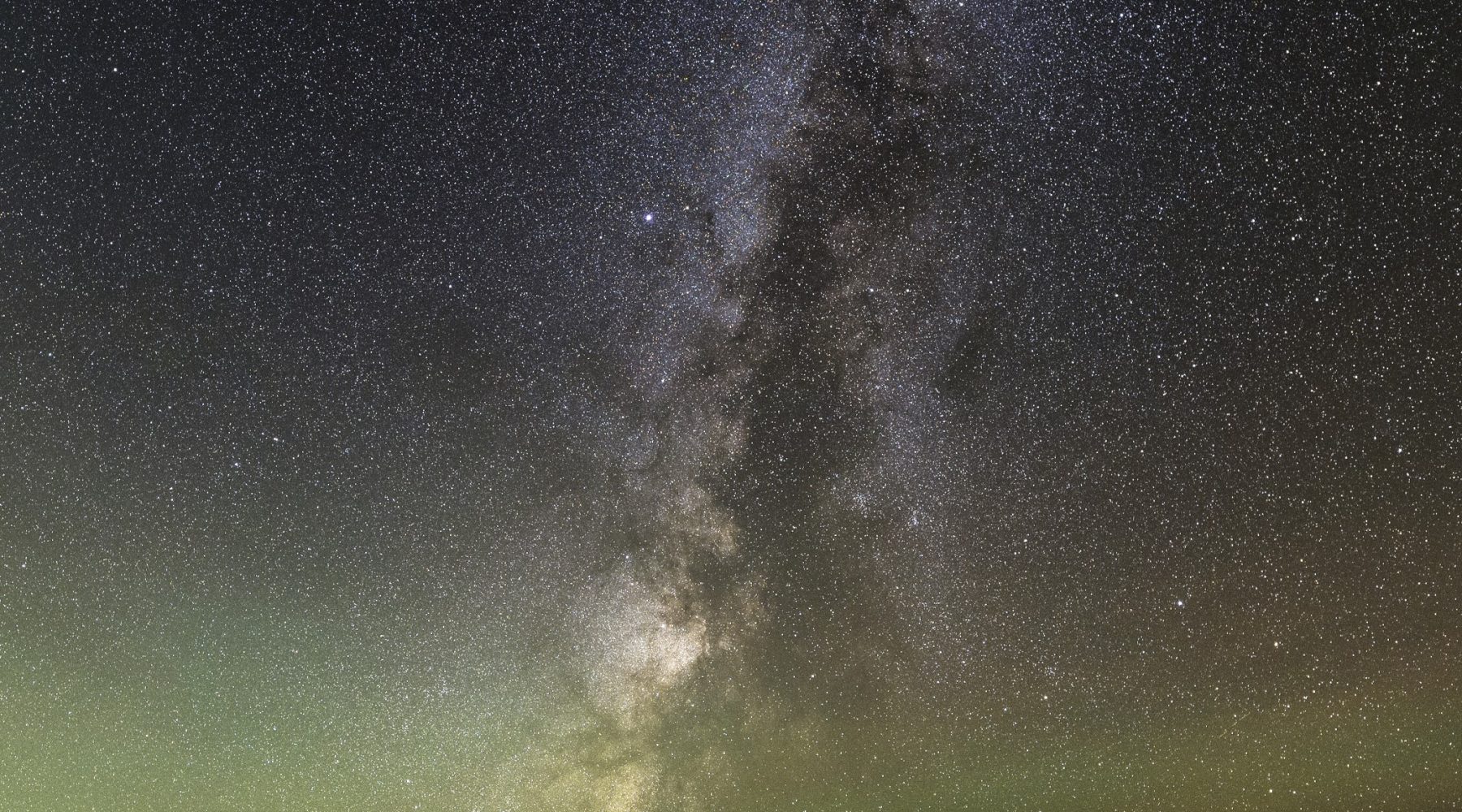
Nyx sits on a stretch of coastline that happens to host two genuinely rare natural phenomena within a few hundred meters of each other: an internationally certified Dark Sky Reserve on the ridge above the lodge, and a protected tidal bay with a naturally occurring bioluminescent plankton bloom below it. Neither is engineered or seeded — both are the reason this specific site was chosen for a lodge in the first place, not a feature added to an existing property.
The dark-sky side of the property is certified against measured sky brightness, not just remoteness — our site consistently reads below 21.8 magnitudes per square arcsecond on a Sky Quality Meter, placing it in Bortle class 1–2, the two darkest classifications on the nine-step Bortle scale. Certification required a documented outdoor lighting management plan across the whole property: every exterior fixture fully shielded, warm-temperature rather than cool-white, and on timers or motion sensors. We re-measure periodically rather than treating the original certification as permanent, since sky darkness is measurably degradable by even a single unshielded light source nearby.
The bay’s glow comes from a resident population of bioluminescent dinoflagellates — single-celled plankton, dominated by a *Pyrodinium*-type species here — that flash blue-green light through a luciferin-luciferase chemical reaction triggered by mechanical disturbance: a paddle stroke, a fish’s tail, your hand moving through the water. The bloom is strongest in warmer water, roughly June through October, and we monitor its density on an ongoing basis as part of our conservation program, since the bay is a protected tidal ecosystem, not a managed attraction.
We run this property as a working ecotourism operation built around both phenomena, with a small number of rooms, a restaurant, and a guide team of naturalists and an on-staff astronomer — not a wellness retreat, and not built around either phenomenon as spectacle rather than science.